
Introduction to IIHR
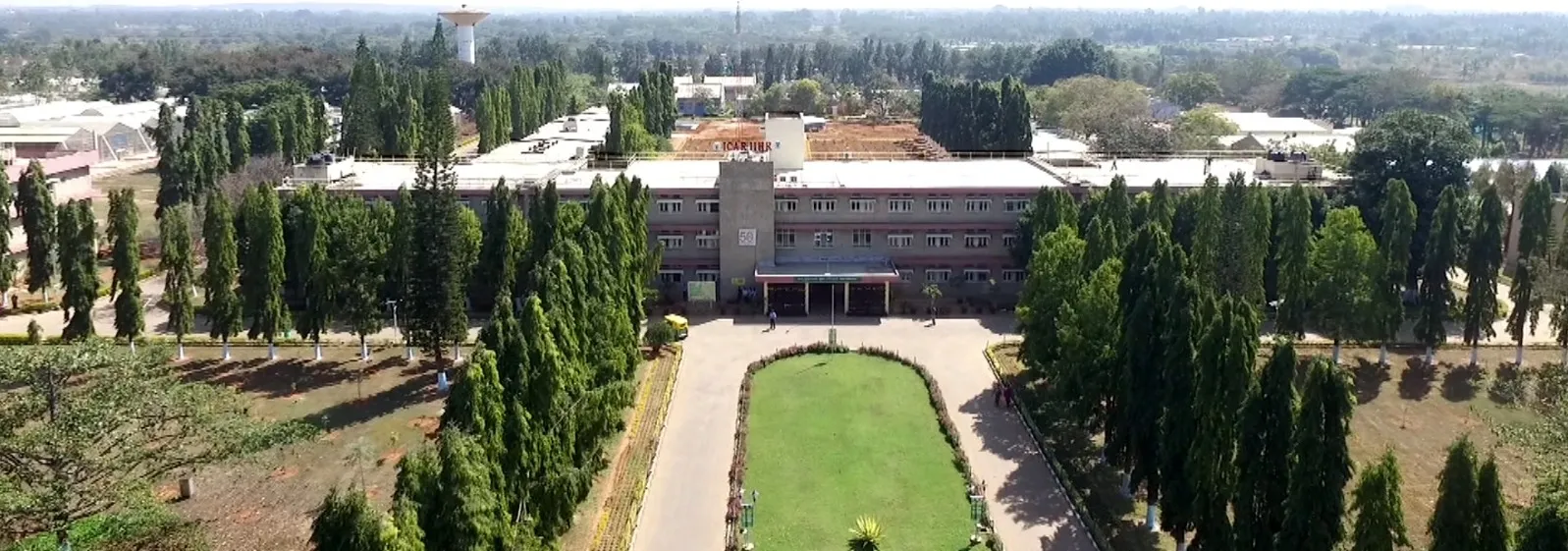
The Institute spread its sphere of Research activities to the length and breadth of the Nation by establishing its experimental stations at Lucknow, Nagpur, Ranchi, Godhra, Chettalli and Gonikopal. Over the years these experiment stations have grown in size and today they stand as independent institutes, however, retaining the Chettalli and Gonicoppal under its fold. As of now, the IIHR has its main research station at Hessaraghatta, Bengaluru with 263 ha of land and Regional experiment station at Bhuvaneshwar in Orissa with two Krishi Vigyan Kendras both located in Karnataka state at Gonikopal in Kodagu and Hirehalli in Tumkur districts. Apart from this, the Project Coordinating Cell of the All India Coordinated Research Project on Fruits is also located at the institute at Bengaluru.
History and Growth
The physical growth of the Institute could be viewed in two phases. The first phase is from 1970 to 1990, wherein emphases were laid on land development and buildings. During this phase, the area for carrying out research and the area for laboratory buildings, supporting buildings and other essential office buildings was earmarked. Accordingly, the entire arable land was divided into well-defined nine blocks for carrying out research and independent buildings for various divisions and departments with laboratories were built.
The second phase of the physical growth was after 1990 during which emphases was laid on creating ultra-modern world class, infrastructure facilities in terms of equipment and structures. Currently the institute has well defined 8 divisions namely, The Division of Fruit Crops, Division of Vegetable Crops, Division of Flower and Medicinal Crops, Division of Post Harvest Technology and Agricultural Engineering, Division of Crop Protection, Division of Natural Resources, Division of Basic Sciences and Division of Social Sciences and Training with more than 65 purpose oriented laboratories having state of art equipment like electron microscope, ultra-centrifuge, LC-MS, GC-MS, GC-EAD, AAS, ICP-OES, SEM, TEM, HPLC, GLC, FT-NIR, Gama Chamber etc., and infrastructures phenomics facility, CTGC facility, FATE facility and a series of poly houses and net houses, growth chambers, mist chambers, cold storage facilities, gene bank, local area network with video conferencing facilities, Seed processing and nursery units etc. Apart from this, the institute houses BESST-HORT — a Technology Business Incubator facility and an ultra-modern library, a conference hall, auditorium, training hostel, Bank, Hospital, essential quarters and few other facilities.
In the beginning years of the institute, the main research agenda of the institute was to increase the yields of horticultural crop varieties by developing high yielding varieties in fruits, vegetables, ornamentals and medicinal and aromatic plants and also develop advanced production technologies to increase the productivity of horticultural crops. With changing times and emergence of new challenges in the fields of productivities, crop production, crop protection and crop utilization, emphasis was laid on breeding varieties for biotic and abiotic stress tolerance, breeding F1 hybrids, developing integrated pest and disease management technologies, developing integrated water and nutrient management protocols towards optimum utilization of resources, developing Post Harvest Management practices to reduce the post harvest losses and further value additions, and frontier research areas like hi-tech horticulture, precision farming, information technology, biotechnological interventions to increase yields, protect crops from insect-pests, disease and viruses, and extension of shelf life of crop produces.
Twice, i.e. during the year 1999 and 2011, the Indian Council of Agricultural Research, New Delhi awarded the Best Institute Award to IIHR, Bangalore in recognition of the institute's progress, achievements, and its contribution to the field of horticulture. The institute is also recognized as the post graduate research and training centre in horticulture by a number of universities as part of PG Education.
The Mandate
To Undertake Basic And Applied Research For Developing Strategies To Enhance Productivity And Utilization Of Tropical And Sub-Tropical Horticulture Crops Viz., Fruits, Vegetables, Ornamentals, Medicinal And Aromatic Plants and Mushrooms.
To Serve As A Repository Of Scientific Information Relevant To Horticulture.
To Act As A Centre For Training For Up Gradation Of Scientific Manpower In Modern Technologies For Horticulture Production And Research.
To Collaborate With National And International Agencies In Achieving The Above Objectives.
Core of IIHR
In the field of production technologies the Institute has standardized the technology of high density planting of banana and pineapple which are being practiced by almost all fruit growers of these crops. Grape rootstock Dog Ridge, identified and released by the Institute has revolutionized grape cultivation in dry land and problematic soils. Integrated water and nutrient management schedules like drip irrigation, fertigation, application of fertilizer in the active root feeding zone etc., for optimum utilization of resources for various fruits, vegetables and ornamental crops have been standardized. The Institute has also standardized leaf and petiole diagnostics for optimum recommendation of fertilizers for respective crops. In the recent years, the institute has standardized technology for foliar nutrition of micro nutrients and has commercially released mango special, banana special, citrus special and vegetable special for higher and quality yields. These technologies have already been commercialized, making these technologies available to cross section of the farming community. The causative factors for occurrence of Spongy tissue, a major problem in mango has been found and accordingly recommendations are made to overcome the problem. The Institute has also come out with biofertilizers like PSB, azospirillum, VAM etc.